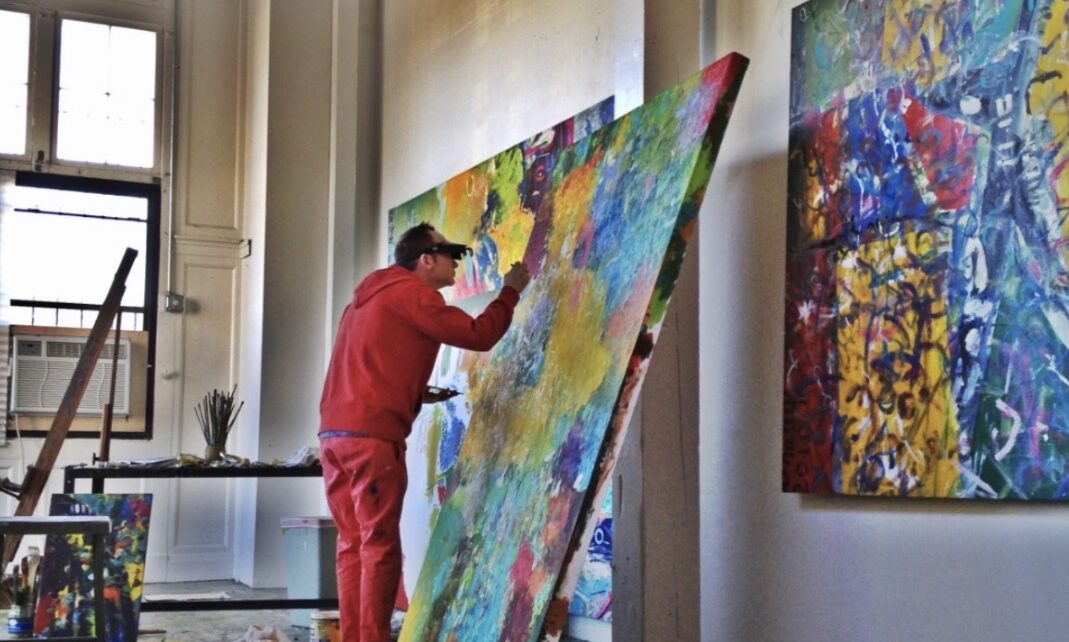
THE DAVYD WHALEY FOUNDATION AT TEN YEARS
I did not set out to run a foundation. In the fall of 2014, my husband Davyd Whaley died unexpectedly, and I became a widower with a great sense of despair and a house full of paintings. I had no idea what to do with any of it — not the grief, not the canvases stacked against the walls, not the strange fact that Davyd had spent two decades in information technology before he felt able to call himself an artist, and then had barely five years to make up for lost time before he was gone.
What I had, instead of a plan, was a conviction he’d left behind like a set of instructions. He always said, “Make art, buy the art of others, help people whenever possible, and try to grow in consciousness.” These four statements became the shape of an organization.
That was 2016. This year the Davyd Whaley Foundation turns ten.
Davyd came to painting the way some people come to a language they didn’t know they already knew. He’d joined the Navy out of high school and served four years on submarines, then went to school to be an electrical engineer, eventually designing phone systems and overseeing many employees at various corporations. And he was good at it, by his own account, though the work never fit him the way he needed it to.
In 2007, he reached a turning point and retired from engineering altogether, certain in a way he hadn’t been before that painting was simply what he was meant to be doing with the time he had. He would travel with me to New York when I was working, and he took classes at the Art Students League, studying under Ronnie Landfield and Larry Poons. These two teachers both encouraged him in his desire to become a full-time artist.
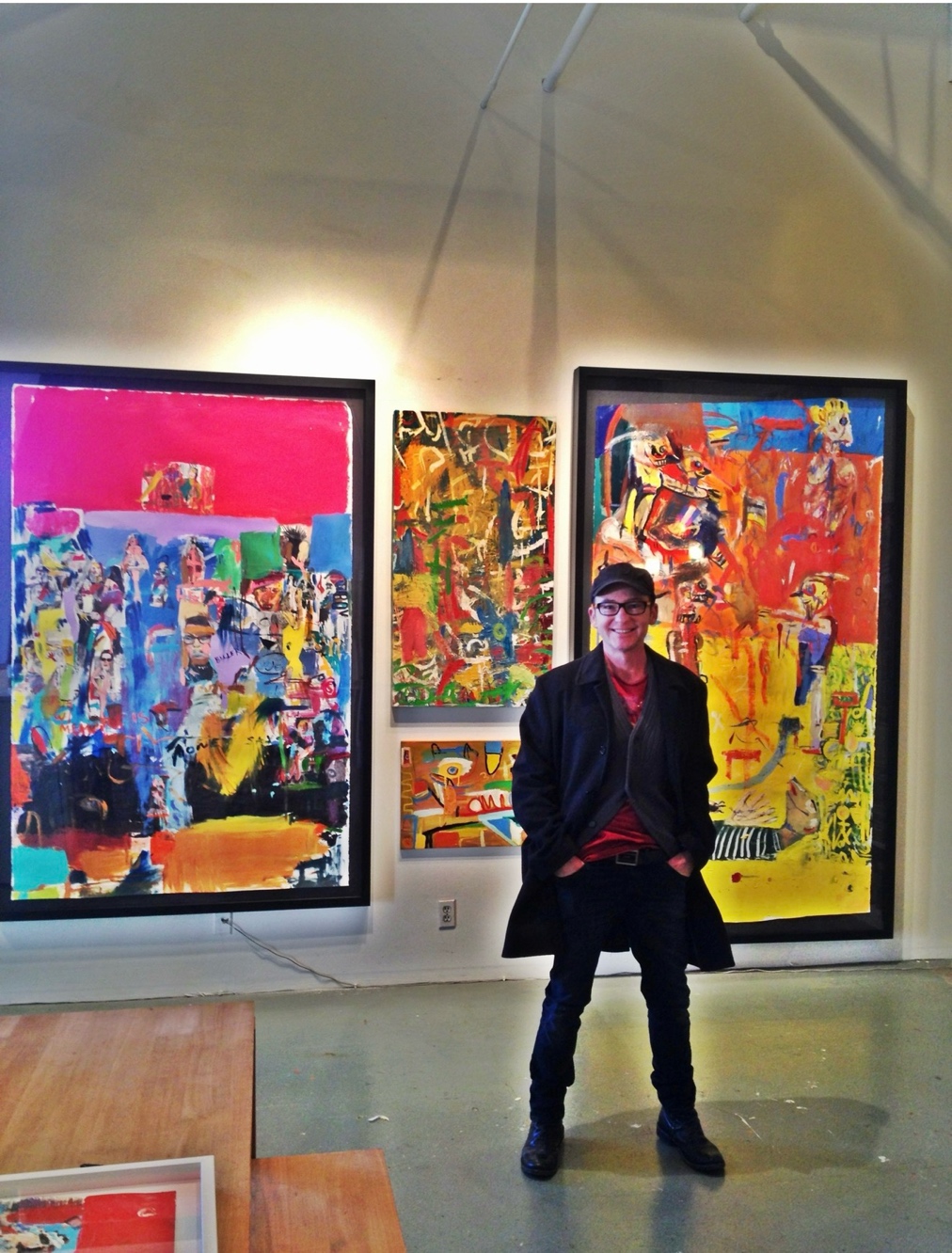
Once he committed to the studio full time, he kept a dream journal at his bedside. He wrote in it every morning the moment he woke, before the images dissolved. Those pages became the raw material for his work. His studio was a loft he kept at the Santa Fe Art Colony back in Los Angeles — two thousand square feet in a converted mattress factory with twenty-foot ceilings, part of a community of some fifty-seven working artists. His process there, once he found it, was almost ceremonial: unstretched canvas rolled out flat on the floor, eight or ten colors mixed and set out in bowls within reach, music loud enough to fill the room — jazz on a good day, Nine Inch Nails when he needed the adrenaline — and then hours, sometimes twelve of them at a stretch, chasing down whatever had surfaced in the night. He believed color wasn’t something you could fully teach yourself; he used to say drawing could be learned, but a feel for color was closer to a gift you either had or didn’t. He trusted his instinct for it above almost anything else in the work. Technically, he was drawn to asymmetry, building up thick ridges of pigment with a palette knife until the surface itself had depth. He called his finished pieces episodes — each canvas one moment, one spiritual sequence, the way dreams arrive to us in fragments rather than a single unbroken story. I used to tell people the art healed him, that he’d found in it exactly what he needed. That was true for a while.
He was, by nature, someone who noticed other people’s suffering before his own. Before he painted full time, he enrolled in nursing school, became a certified nursing assistant, and spent a year volunteering at Kaiser Permanente, sitting with the families of patients in intensive care.
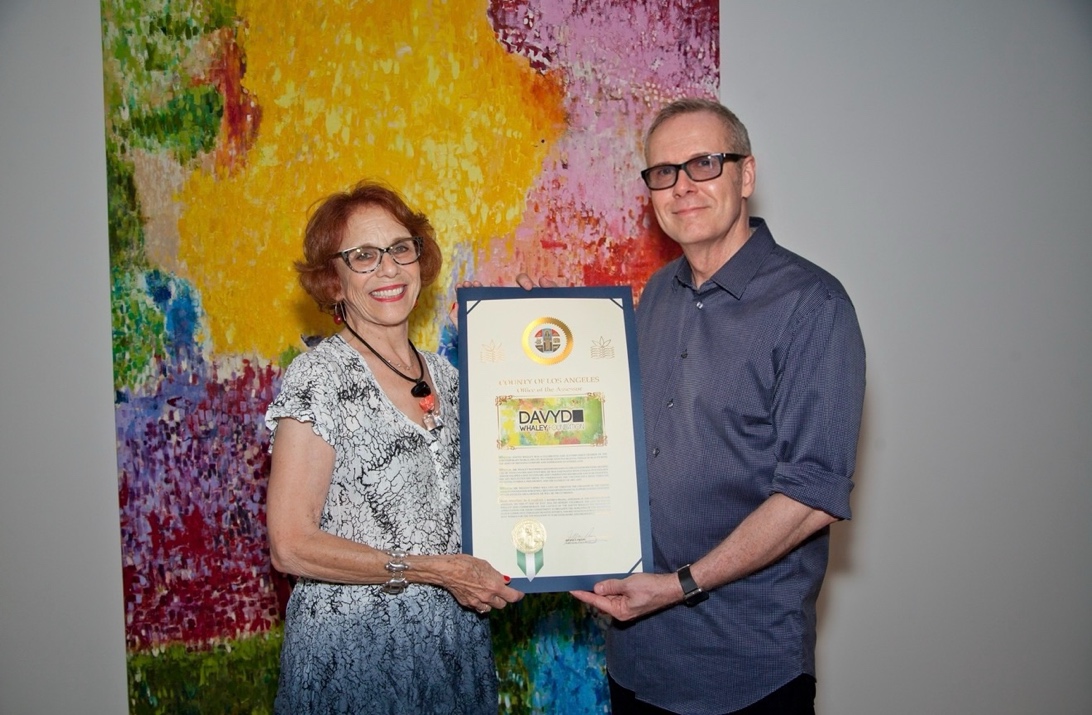
In 2011, he discovered Los Angeles County had an arts budget that was going unused. He proposed starting art classes at their community centers for seniors and underprivileged kids — he’d seen the need. He made the case, drawing up the cost-benefit analysis himself to get it approved. The following year the county named him Volunteer of the Year for exactly that work, an honor he called one of the proudest of his life. He kept teaching those classes for as long as he was able.
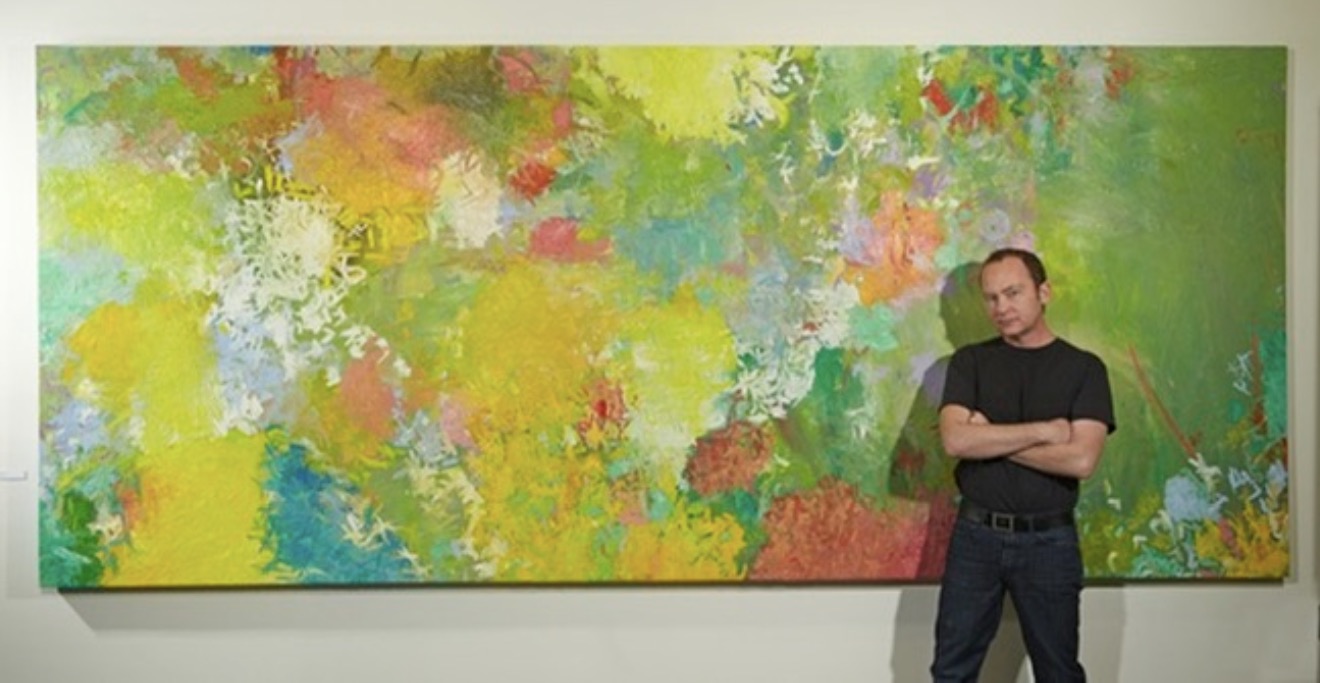
It was one of his large early canvases, featured at a Hollywood benefit for The Art of Elysium, that first caught a gallery’s attention. Kristan Bonde, from Galerie Michael in Beverly Hills, saw the painting, tracked Davyd down, and, within the year, Galerie Michael gave Davyd his first major solo exhibition. The same year, one of his paintings, Heaven and Hell, was selected for the Florence Biennale in Tuscany. His paintings quickly started selling, and most of his work is in collections all over the world.
For Davyd, making art and giving other people access to making it were never two separate projects. They were the same one. The paintings themselves keep circling a handful of images he returned to again and again — a figure he called Hero, a pair of black birds he named Blackie and Pearl and considered his companions on the road, a recurring exploration of what Jung called the anima, the feminine principle he felt moving through his own psyche as much as through the women he painted. He wasn’t interested in beauty as perfection; one series he made was explicit about that, insisting that the assumption that beautiful people are somehow whole or untroubled was itself the thing worth painting through. In his final full year of work he pushed further still, into a series built around light and the physical universe itself — reaching, in his own words, past the personal story he’d spent years working through and toward something larger, more transpersonal, something closer to pure light and space than to any single life’s narrative.
I think about his trajectory a great deal when I think about the Foundation. It’s not a monument to a story that ended, but a continuation of a direction Davyd was already moving, toward something larger than himself, art as a way of reaching other people rather than a way of processing only his own history.
Which is why I want to mark this tenth anniversary of the Foundation that bears his name. The Davyd Whaley Foundation has transcended his particular, tremendous, remarkable life. I hope that other artists have felt this wind at their backs. I know that Davyd lives on in many whose lives he touched. That list is long, and I am at the top.
The Foundation would not have come into being without the support of the late Ellie Blankfort and her husband, Peter Clothier. The idea for it came one night as I sat at their home over coffee, while we discussed how to keep Davyd’s spirit alive. Ellie had a vision that I hope I have successfully carried forward these last ten years.
And the Foundation wouldn’t have continued without the support of Nick Brown, Kristan Bonde, Anitra Kyees, and Krista Machovina. Nick had been one of Davyd’s teachers; Kristan and Anitra had initially worked at his gallery; and Krista had worked with Davyd at the Art of Elysium. I am grateful to all of them for helping me keep our mission intact. I’m also grateful to Galerie Michael, who helped me sell almost all of Davyd’s remaining work (except for the pieces I decided to keep). That money has gone toward sustaining the Foundation.
Over its ten years of existence, the Foundation’s goals have evolved in many directions – awarding individual grants, providing residencies, supporting scholarships at various institutions, funding art shows, and offering support to various arts organizations. This year, the Foundation continues its ongoing relationship with Art Division.
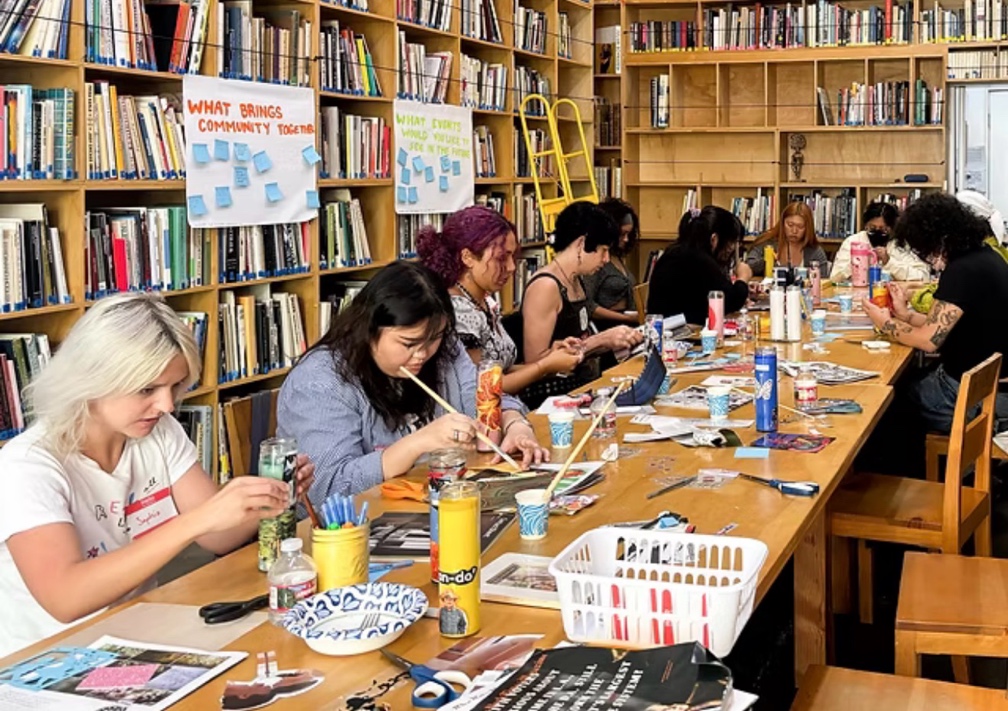
Art Division might not be well known outside the circles that need it most, which is more or less the point. Dan McCleary — a painter himself, with work in the collections of the Met and LACMA — founded it in 2010 out of frustration with something he observed happening at arts organizations – students with real talent, and a real hunger for learning, would turn eighteen and fall off a cliff. No more youth programs. No bridge to anything. Just a gap where a future should have been. So he built the bridge himself, in the Rampart District, a few blocks from MacArthur Park — a campus now with painting and printmaking studios, a public gallery, and a library of more than ten thousand volumes that students can actually sit with, not just check out and return. In fifteen years they’ve worked with over nine hundred young artists, most of them eighteen to twenty-six, most of them navigating exactly the economic and racial inequity that makes “just pursue your art” sound like advice from another planet.
Davyd would have recognized that instinct immediately, because it’s the same one that drove him to teach seniors on weekends in East Los Angeles, even as his own painting career was beginning to take off. He believed that talent reveals itself everywhere, and it is only access that’s unevenly distributed. Art Division doesn’t wait for its students to have a foothold already. It builds the foothold. That’s a literal description of what a bridge program does for an eighteen-year-old with nowhere else to go with what they can do — not so different, in spirit, from what a young, curious boy like Davyd did with an art teacher’s advice at his high school in the Appalachians, and how he discovered the importance of paying it forward, offering a helping hand wherever he could find the opportunity to do so.
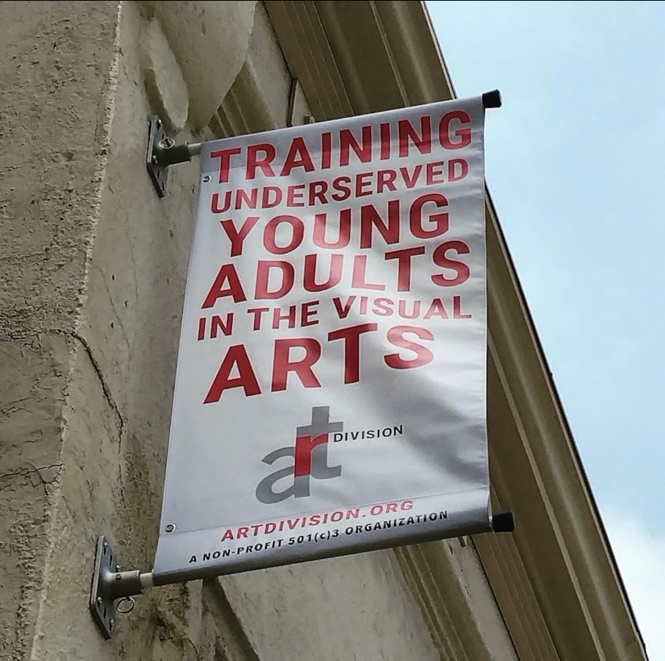
Davyd would be proud, I think, because Art Division is doing exactly what he felt was important. He would be prouder still to keep that association going into this next decade. Ten years isn’t a culmination. It’s hopefully ten more young artists who get a little more room to work than they would have otherwise. It proves what Davyd always believed: that you don’t have to wait for the art world to open its doors. Sometimes you build another door, somewhere it’s needed more.
http://davydwhaleyfoundation.org
Leave a Comment