SCAN LINES
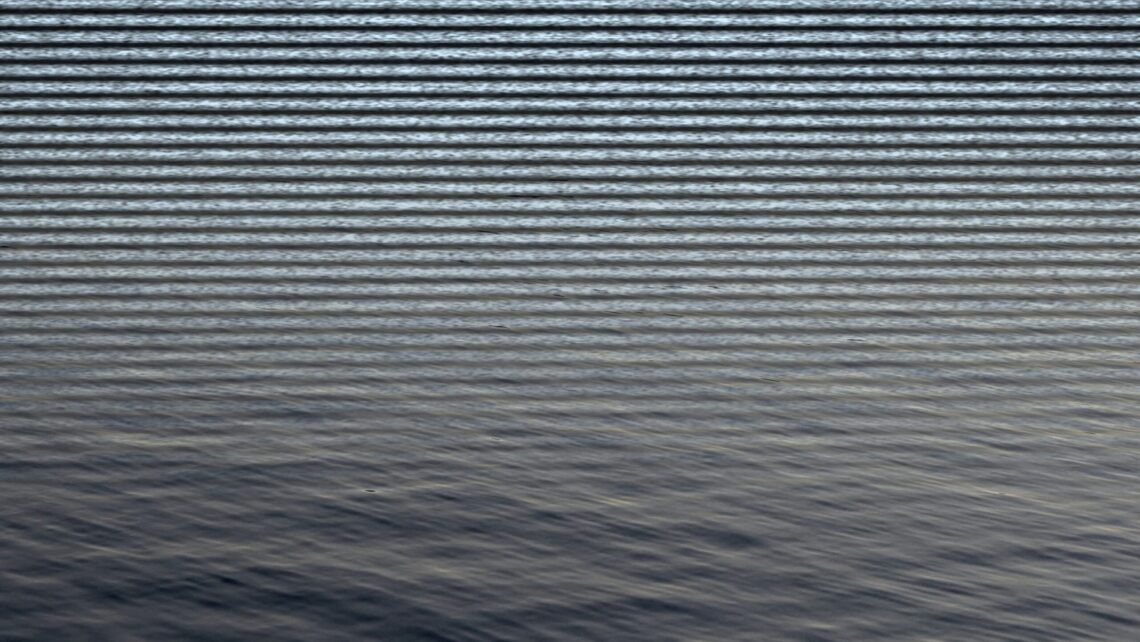
I walk in the half light before dawn, the water beside me not yet blue. The images float towards me. Black-and-white memories from old television sets, with scan lines like these reflections on the water. Scratchy audio in my ear, from times past, like a beacon.
I cannot remember when I became conscious of television as a conduit to the larger world. The awareness arrived gradually, my eyes slowly adjusting to a light that was always there, another thing cohering from the formless. I remember the images emerging as I gaze at the water.
I am four or five, with my parents in our living room on the west side of Fort Worth, watching the screen of a boxy set. I explore the larger world through the people in the box. They are emissaries from somewhere I have not yet been, modeling a life I cannot yet name.
Sometimes now, late at night, I scroll on my phone, down a YouTube wormhole, and arrive back in that living room. I stumble over an old broadcast I barely remember, a face I haven’t thought about in decades, and the algorithm, feeding on that drift, offers another, and then another, and I go where it leads.
Talk shows from the fifties and sixties, grainy newsreels: the dead, performing. Once as blurry as the water I walk beside, the footage resolves, upscaled until 1955 feels like last week, the week I was born, the week my consciousness first emerged into this dimension. The distance collapses. I am more present to the dead than I ever was when they were alive.
I move through the archive. What’s My Line? An old CBS panel show, the one that ran from 1950 to 1967, back when television was still an event rather than an environment — still a family gathering, an after-dinner ritual. Something restless within me settles as I watch it.
* * *
I grew up in Fort Worth — a city of oil and ranch money. Wide streets and a particular self-certainty, on the edge of the West. The screen offered a window into another, more cosmopolitan world that felt both impossibly distant and somehow available. New York there in the box, with its density of intelligence and style, its assumption that ideas are the most interesting thing a room can hold. The panelists on What’s My Line? inhabit the world effortlessly, or appear to — and in those years, the appearance is instruction enough. Here is what a certain kind of life looks like: the pace of the wit, the pleasure of the well-turned question.

Three regular members sat on the panel, with a fourth seat that rotated. I remember Arlene Francis. She smiles, tilts her head, reads a person from a syllable. She makes whoever she is speaking with feel like the most interesting thing in the room. Dorothy Kilgallen offers a journalist’s mind, retrieving exactly what is needed at exactly the right moment. Bennett Cerf, the Random House publisher, seems to love language, both as a profession and a physical pleasure.
Sixty-five years later I recognize something I could not see coming then: they are all gone. Not just the panelists, but the mystery guests — the actors, the athletes, the politicians, the luminaries of a mid-century world. An entire procession of people who moved through those studios at the height of whatever they were, alive and charming and entirely unaware that decades later someone will watch them in the dark. Vanished. And yet… not — which is the thing I keep turning over. They are fully present on the screen. They are completely absent from the world.
Nostalgia is selective, of course. The particular civilization represented on What’s My Line? has its omissions — its aspirational image incomplete in ways the coming decade will make undeniable. The show never mentions the emerging social undercurrents of the late fifties and sixties — the Cold War, the civil rights movement, the increasing challenges to the accepted narrative. Nostalgia often doesn’t either. I wouldn’t go back, and yet I still reach for it. I reach towards a question I cannot answer by staying there, and I reach for something I only half remember, which the light along the water keeps almost bringing back.
* * *
The show’s central question — what’s my line? — meant: what do you do? What is your occupation, the thing by which you would be identified if the panel were guessing? But the phrase keeps opening beyond that. What is the line of a life? What is my line, at this distance from the boy who watches these people and feels the pull of what they represent?
I have spent many years in a profession that is itself a form of this question — the director’s work is to find the through-line, the thing that makes everything else come together. But the question has another register, and it grows more insistent with time. What’s my line? What is the essential thing, the purpose of a self that goes deeper than the work?
To call myself a director gives me a line to offer, a story, an account of what I have done with my time. But lately, on these morning walks along the water in Vancouver, and this morning more than most, the definition starts to evaporate. I try to locate myself within it and cannot. I am so much more and, in the same moment, feel like nothing at all — a kind of unexpected spaciousness.
The French philosopher Frédéric Gros writes about walking as the practice that releases us from exactly this obligation: “By walking, you escape from the very idea of identity, the temptation to be someone, to have a name and a history. Being someone is all very well for smart parties where everyone is telling their story, it’s all very well for psychologists’ consulting rooms. But isn’t being someone also a social obligation which trails in its wake — for one has to be faithful to the self-portrait — a stupid and burdensome fiction? The freedom in walking lies in not being anyone; for the walking body has no history, it is just an eddy in the stream of immemorial life.”
An eddy in the stream of immemorial life. I walk with this, as I watch the ships float by on their way somewhere.
* * *
The water is slate now, no longer black. But a question lingers beneath the nostalgia: what are we, exactly? Not who — the show has a structure for answering that. But what? What is the substance of a person, behind the erudite wit, the journalist’s precision, the full-throated laugh? And what happens to it?
The ideas come the way the picture used to, through a dial turned slowly. There’s a click, and a station swims into focus; another click, and it dissolves into snow. I walk, and in my mind I turn the dial.

Out on the water, a freighter rides at anchor, its lights small and steady in the dark, unloading who knows what to someone somewhere. I think about consciousness the way I think about our devices. I am not sure about this analogy — it remains vague in my mind — but it’s the one that keeps floating by, as the cranes remove containers in the distance. The brain seems to be a transmitter with designed obsolescence, refined over unimaginable time to do extraordinary things, and built, like everything else, to fail. The device will always fail.
I imagine myself before the old television set, sitting on the floor, my parents on the sofa behind me, reaching for the dial, turning from one channel to another. An image swims into focus. The picture is never whole at once; instead, a beam draws it line by line. My eye lags a little behind, holding the earlier lines in place long enough to call it a face. The picture rolls, tears, and will go to snow. My dad gets up from the sofa and adjusts the rabbit ears. It seems real, but the reconstruction is not the person. And still I wonder.
Snow is not absence. Perhaps the signal lives somewhere other than the device. The information outlasts the TV set on which I first watched, and the phone that carries it now; it moves from one machine to the next. Physics, insofar as it speaks to this, says that information cannot be destroyed. Only transformed, dispersed, scattered beyond practical recovery — but not annihilated.
A seaplane lifts off the water like a thought, loud for a moment, then gone into the grey, and not gone. I don’t know what to do with this exactly. I’m not sure it means what I want it to mean. But I can’t dismiss it.
I continue spinning the dial, and two men I’ve read wander in and out of range. Donald Hoffman, a cognitive scientist, suggests that what we see — the water, the towers, the mountains along the harbour — is not reality but an interface, a desktop of icons, a useful fiction evolved for survival rather than truth. The brain does not generate consciousness; it is one more icon on the desktop.
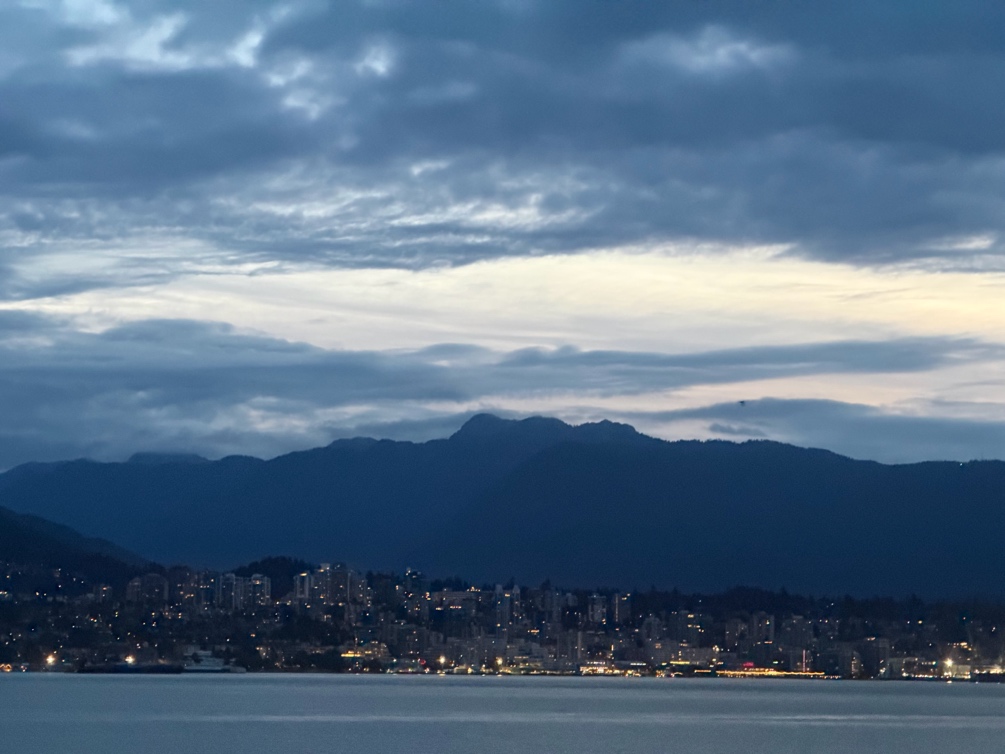
On another station, Bernardo Kastrup goes further. He calls it analytic idealism: consciousness being the ground of everything, and each of us a whirlpool in a stream that is not ours, shaped for a time and then released back into what was always there. I gaze into the whirlpool.
Then below the stations, in the hiss between them, a tradition among the oldest in human thought has sat with these questions far longer than Western philosophy has existed. The Vedantic texts — Schrödinger reads them beside his physics and finds them confirmed rather than contradicted — say that the self is not something the brain generates and then extinguishes. Many call this Brahman, universal consciousness, temporarily localized into a particular form. The wave is the ocean. In this telling, the information was never only in the device. I have read that a sliver of the snow between channels is the afterglow of the beginning of the universe, a signal still arriving after all these billions of years.
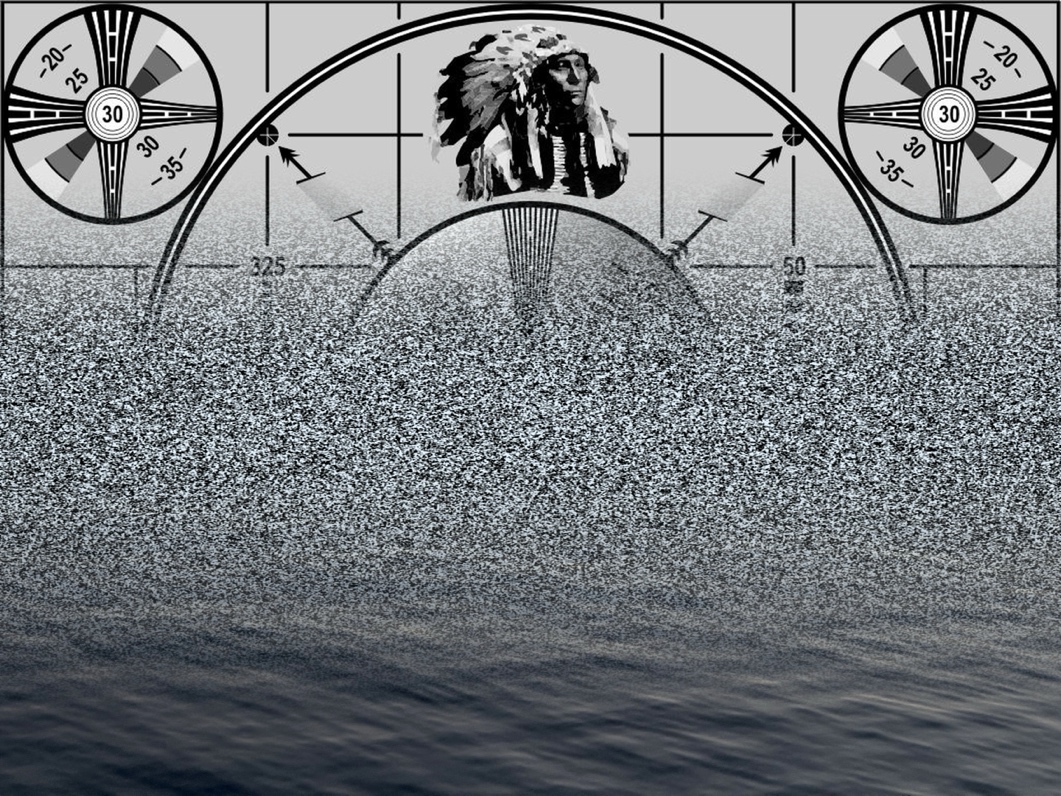
I stop turning the dial. Across the harbour, lights in the towers come on one by one, small screens of their own, other stories playing out. I reach for these frameworks the way I would reach toward a lit window — not because I can verify anyone being there but because the reaching feels less improbable than the alternative: that the wit and warmth of those people on the screen simply ceased, that the apparatus is the whole of what a person was.
* * *
Dorothy Kilgallen appears on What’s My Line? for the last time on Sunday, November 7, 1965. She asks her questions. She correctly guesses the final guest’s profession. She will be found dead the following morning in her townhouse on East Sixty-eighth Street, from alcohol and barbiturates, the circumstances never fully resolved. She has spent the prior two years trying to make sense of the Kennedy assassination, and the lore follows her through the digital wormhole.
Bennett Cerf dies in 1971, the sophisticated persona extinguished at seventy-three, of complications shortly after surgery. And Arlene Francis — the warmth of the show itself — develops Alzheimer’s disease and dies at ninety-three. Alzheimer’s is merciless to the witty. It dismantles the rapid retrieval of language, the connecting of disparate things, the very qualities that made her who she was. It removes the quickness, the humor translated into the right words at the right moment. It erases the instrument.
And yet. I watch her now. On a screen in Vancouver, decades after Fort Worth. The tilt of the head when she zeroes in, exactly itself. The device is long gone. The information remains.
What does that mean? Is it only the recording — light and shadow preserved by accident on tape, sharpened now by an algorithm that has never heard of Arlene Francis? Or is it evidence of something the tradition has been trying to say for three thousand years: that the wave, when it dissolves, was never apart from the ocean? I stare at the water, wondering.
I think of my many hours in dark rooms, editing: I make the cuts. I hold the faces a half second longer than the lines themselves. All of that work sits somewhere now on a screen or a server, waiting for someone I will never meet to watch it late at night, to keep them company. Perhaps someone will watch my work the way I watch these old shows.
I already know the other end of this. I watch videos of my mother at ninety-nine on the small screen of my phone, and for the length of the clip she is entirely there. I watch others I’ve lost too. I watch my husband Davyd, dancing for me on a beach, in a blue hoodie. He runs towards the camera, laughing, covering the lens with his hand. The frame goes to black and I’m left staring at my own reflection.
And if it all continues, even in another form, so does what made it. I did not arrive here this morning alone. I am what I have watched and read. I am a long relay of other people’s attention: the authors of books, whose sentences I still hear under my own. I am what I have heard, as the great loves of my life still whisper in my ear. I am all those hours of flickering light. I have been shaped by the panelists whose pace of wit I absorbed as a child. And before any of that, I am the extension of my parents who sat beside me while I watched, whose faces I can no longer quite see, because we were all watching the same thing.
I look across the harbour. What I cannot know is whether anyone is home. But the thoughts I am having now, on this walk, at this hour, are not staying here either. They go onto this page, perhaps into a stranger’s morning, into another mind that picks them up and carries them a little further. Ideas often don’t stay where they came to mind. They are the crest of the wave, the leading edge, where consciousness presses forward into whatever it becomes next. For the length of this walk, I am part of the crest, carried by every wave behind me, the two on the sofa among them. I notice how much I want this to be true. I let myself have it anyway, for now.
* * *

The light comes up over the water now. The grey turns red. It lingers a few moments, and even that changes. I look back at the boy in Fort Worth, watching the panelists in a box. He is learning that the gap between appearance and reality is where the interesting things live. I am still in the gap, still in the wormhole. What’s my line? I watch for an image that answers.
The panelists do not know I am remembering them. They keep asking their questions anyway.
Leave a Comment