BEBO ON THE BEAT
My mother has been gone for a year. I’ve been traveling on the road, wandering, working, and missing the anchor that held so much of my identity in place.
I reach for the phone to call her, to check on her, to tell her about my travels, about my day. Then I catch myself, wondering how to live my life now without her on the other end of the phone, asking what I’d done, who I’d met, how I felt about it.
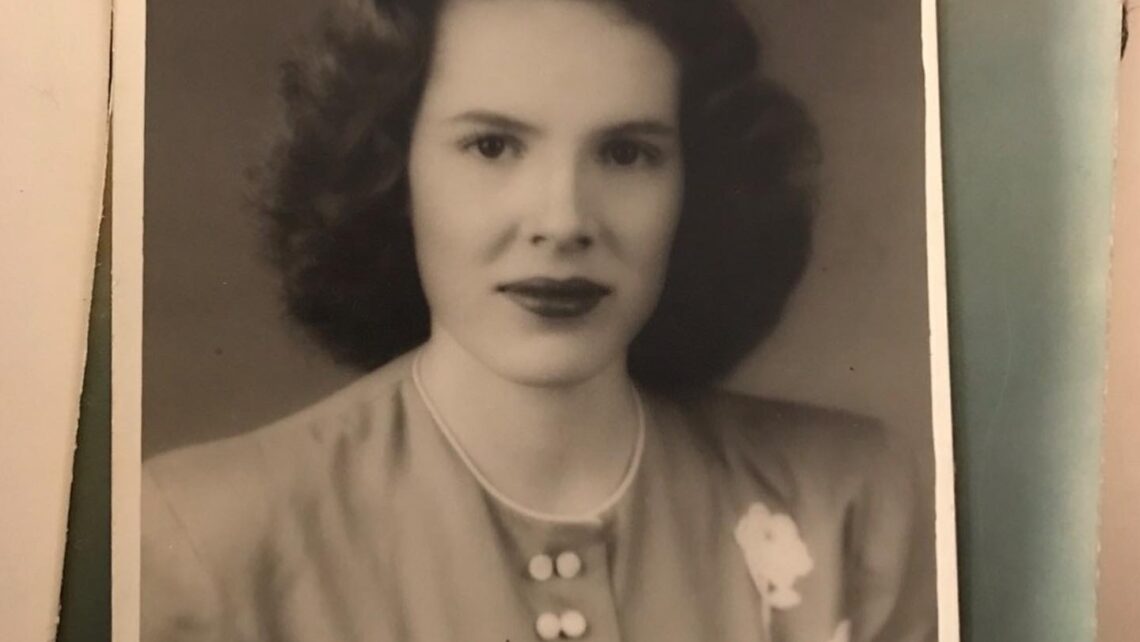
Betty Bob Buckley—Bebo, to those who knew her best—was a reporter until the very end, and she always wanted to know what came next. She lived to be 99, which means I spent almost seventy years never knowing a world without her.
I’ve decided to keep my mother’s house. I am in the process of remodeling it to give myself a new anchor amid my nomadic existence. It feels comforting to return to the cozy home where she lived in her final years and now to call it my own. The garage is still full of boxes; inside them, the remainder of her life—letters, notebooks, clippings, photographs. Two months ago, we delivered eleven plastic bins, the first load of her archives, to the special collections at the University of Texas at Arlington library. Her work will survive.
The scrapbooks are thick with her clips from The Big Spring Herald, the local newspaper in her West Texas hometown. She began working there when she was sixteen. Her first front-page story was on D-Day, June 6, 1944, when she was eighteen. Her trajectory was always up.
Tucked among the scrapbooks, I found a letter from January 1946, addressed to a friend, full of a sharp young woman’s clear-eyed observations about power. She had written it to a journalist named Gem Bob Calley at the Lubbock Avalanche-Journal, who had asked her to share her thoughts with students at Texas Tech about her career in journalism, based on her time writing for the Big Spring paper.
“Jobs are not growing on trees, but the possibilities for women in journalism are endless. Of course, I realize big jobs aren’t being dangled before a person now, since the war’s end and the return of the men. Where a year ago, many girls armed with new diplomas stepped into full reportorial beats or copy desks — now they may have to read proof or help on the society desk. While these jobs may be small, they often lead to better ones and give a more rounded foundation.”
She was twenty years old. She knew exactly what was happening. Women who had filled reporting jobs during the war were being edged out, and she described it clearly, as a journalist would. She said there were still openings and she intended to use them.
“Not only is my job experience enlightening, it’s fun! Meeting people is one of the many engaging aspects of it. A most desirable feature of being on an assigned beat is that even though the same route is traveled daily throughout the year, there are potentially 365 changes, modifications, amendments, or elaborations.”
Her Big Spring Herald beat ran from City Hall — which housed the fire department, police headquarters, the building inspector, and “the hive of activity that is the city manager’s office” — to the Chamber of Commerce, which she described as “a rumor factory from where one can begin the chase,” to the Ration Board, the Health Clinic, the radio station, schools, hospitals, morticians, hotels.
“In a manner of speaking, I have my finger on the pulse of the community here.”
But the most striking passages in the letter are not the charming ones. She wrote about the police beat with the same precise, unsparing eye she brought to everything else. She sat in on the trial of a nineteen-year-old woman charged with prostitution—who later, at the health clinic, told her how she’d gotten there.
And then there was this, witnessed in the local police chief’s office:
“I heard him tell a 20-year-old girl she didn’t have a case on a man she was trying to charge with rape, in that she drove the car to an isolated spot where the act occurred. He told her he didn’t blame her for being mad, because the fellow beat her up, but as a married woman, she shouldn’t have been in his company. The man got off with aggravated assault.”
She witnessed that. She wrote it down. Gem Bob sent the letter back with editorial corrections—suggesting she soften her irony and blunt her analysis of the power structures at play. Her version was better, so she kept it; no editorial comment needed. She was already documenting the distance between what power said in public and what it did to people in private. She had no illusions.
She had learned, she told me much later, everything she needed to know about human nature from her time on the police beat — and it had taught her to be kind: so many others had lives far more difficult than her own.
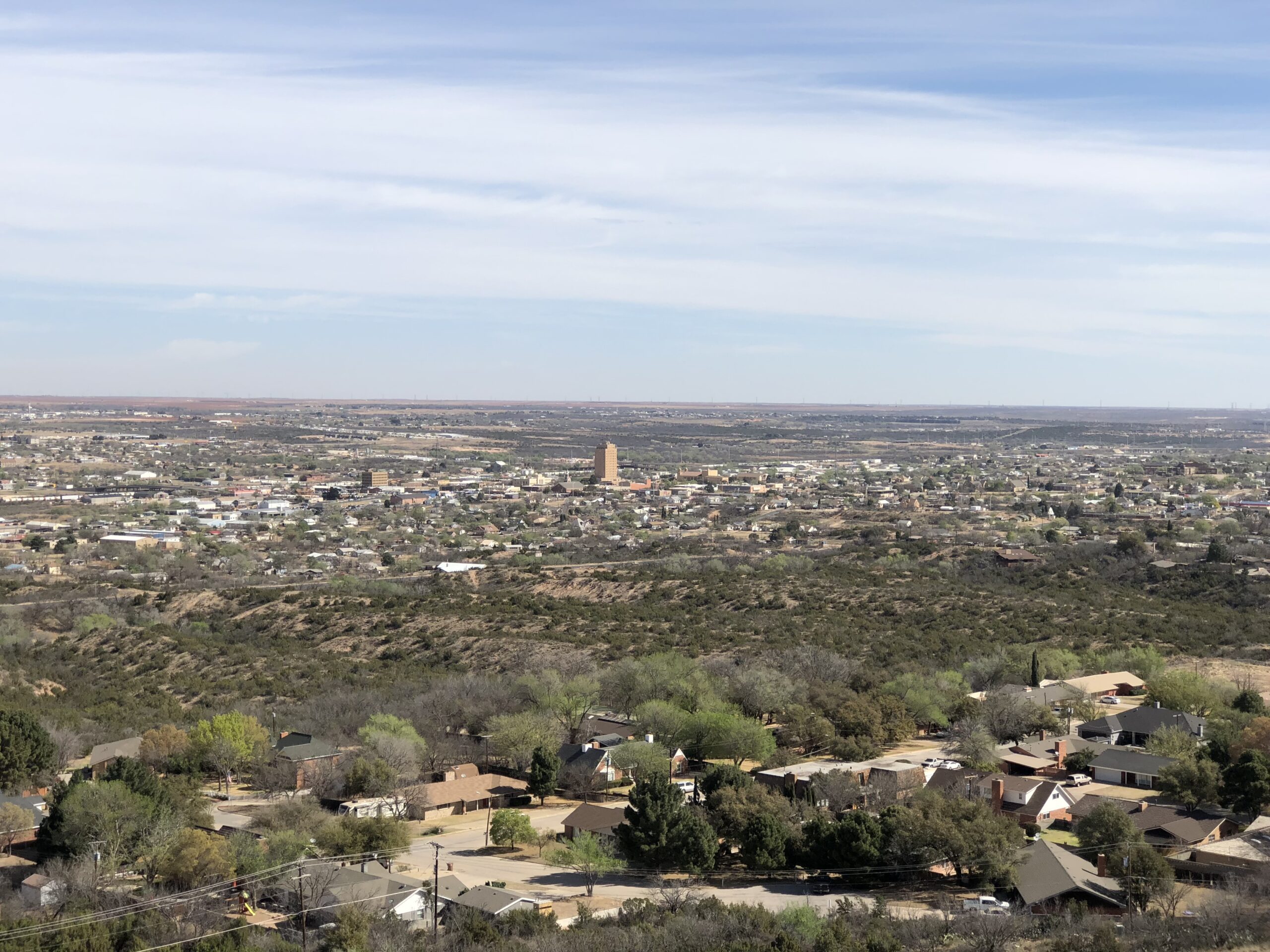
She hadn’t walked that beat in nearly eighty years.
I took her back when she was 97, two years before she died. She knew every house, every street. She described the smell of her father’s bakery and showed me the stores where her mother had worked. We drove up to Scenic Mountain, with its beautiful view of the town, where my father first proposed to her—she turned him down.
She laughed as she remembered.
Two years before our trip, when she was 95, she sat down for me on camera. She read from something she had written about her beloved hometown (unsure exactly when she’d written it.)
“Picture this: the Settles Hotel, about 12 stories high, built right in the middle of Big Spring, a nice little town of about 15,000 people, back in 1942. Surrounding Big Spring on the south and southwest sides were what we called South Mountain and Scenic Mountain. At night, you could see the gas flares burning. Down on First Street, at the end of Main Street, was the Texas and Pacific Railroad, and beside it was the depot.”
She described dragging Main Street in her brother’s car; hiking up the mountains on Saturdays with a lunch; the “thrill bumps” on a stretch of road the teenagers took much too fast; dancing at the open-air pavilion; singing at the amphitheater. She was happy. Then, without ceremony, she added:
“I didn’t even mention the cadets coming to town, and what a gay old time that was. I had so much fun. I was a good dancer, and they would always give me a rush when I was out there.”
The cadets were everywhere in wartime Big Spring — young men from the Army Air Force training base, passing through on their way to a war some of them would survive and some wouldn’t. One Sunday, she came home late from a day that had included lunch at the officers’ club with one fellow, a movie with another, and found a third man waiting at her mother’s house. That third man was my father — Ernest Lynn Buckley. He was persistent, and I guess I should be glad he was. He finally wore her down, though I wonder what her life might have been had he not.
When I asked her about it on camera decades later, she laughed:
“I didn’t know I was going to talk about this.”
• • •
A year after her death, I am still unraveling her story.
To understand what she was doing at 18 in Big Spring, it helps to understand what she’d already survived. I say “survived” deliberately. I didn’t take in how hard her life was until many, many years later, because she never said so. My mother never complained. She described. There is a difference.
Her father, Clinton Sawyer Diltz, was a World War I veteran who returned from service and became a baker, moving the family — her mother Mary, her older sister Mary Ruth, her brother Joe, and eventually my mother, born November 1, 1925 — across a series of towns: El Reno and Tonkawa in Oklahoma, then the Texas Panhandle, and finally Big Spring. The Depression took his bakery. What it took next was harder to account for: he abandoned the family and joined a carnival.
Her mother, Mary, had a nervous breakdown and retreated to her own mother’s house in Marlow, Oklahoma. The children scattered to various relatives and made out as best they could. It was decided that my mother should live with her paternal grandparents in Chickasha. She had been there only a few days when she was in an automobile accident with her grandparents. She was knocked unconscious. Her grandmother was killed. She moved back to Marlow to her mother — and became, at ten years old, Mary’s caretaker. Mary Diltz lived to 97. My mother was beside her for most of it.
In 1937, my mother, grandmother, and aunt moved back to Big Spring, then lived in a series of rooms, garage apartments, and other people’s houses. Mary worked at the bakery, now owned by a young man who had previously worked for them, and also at a ready-to-wear shop. Mary Ruth taught dancing to help support the family and was part of the chorus during the summers at the original Casa Mañana in Fort Worth. Mary and my mother would travel with her, and it was at Casa where my mother developed a lifelong love of musical theatre.
Her father, meanwhile, died in December 1938 at the Veterans Hospital in Muskogee, Oklahoma, after a minor hernia operation. She described what happened with her customary precision:
“We were told that another patient hit him and he fell, causing a brain hemorrhage. Both men were ill and shared a room. My dad couldn’t breathe, and he raised the window. The other man told him to just put it down. That caused the problem.”
The VA helped her mother attend the funeral. My mother and her sister stayed behind in Big Spring — there wasn’t money for the trip from Texas to Oklahoma. Her brother Joe couldn’t be reached because they didn’t know where he was. She was thirteen years old and could not go to her father’s funeral.
In my youth, I only knew my grandfather had died—I think they said “a stroke.” I saw his picture on the wall of my grandmother’s house. I had always assumed they were all very close, but my mother told me years later she barely knew him.
I have a video of her at 97, reading an essay she wrote about him. She speaks about her father compassionately, without bitterness or blame. No self-pity. No performance of hardship. Just the facts, ordered carefully, the way a reporter does it.
After her father died, Joe came back to town, worked at State National Bank, and picked up other jobs as he was able. At fifteen, my mother got a job at the five-and-ten-cent store on Saturdays. She sold perfume, making five dollars a day. “We all pitched in,” she said.
Then the war came. Joe put together a sandwich business to sell to the troop trains coming through Big Spring. The whole family helped prepare them. Then Joe went overseas — joining a medical squadron in China. He was killed in May 1945, three months before the war ended in August. Before he shipped out, Joe had arranged for $1,000 to be held at his bank and given to my mother when he died. She used it for her wedding.
“Joe was always a great big brother to me.” She said it the way she said most things — plainly, with the full weight of the fact, and then she moved on.
• • •
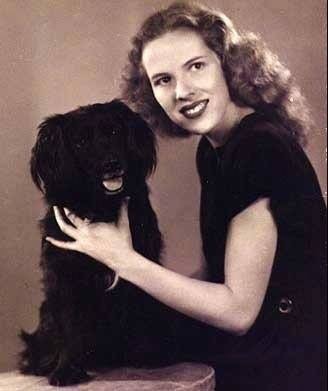
At sixteen — the year before Joe left for the war — my mother started working at the Big Spring Herald and wrote under the name Bebo Diltz. There is a photograph of her with her dog, Byline, named for the journalistic term. The dog knew her route so well that he sometimes ran ahead of her as she made her rounds.
She proofread. She wrote society. She marked pictures. She did a little bit of everything, and her editor believed in her. She began writing feature stories. Her editor’s name was Joe Pickle, and she credits him (and publisher Bob Whipkey) with encouraging her to go to college. She even thinks they helped pay her tuition.
On camera, she tells me of how much she owes Pickle. She reminisces about asking him why he didn’t go to work on a paper in one of the bigger cities. He told her he’d rather be a big fish in a little town than a little fish in a big town.
I say to her from off camera: “And then you moved to the big city and decided you wanted to be a big fish in a big town.” She smiled wistfully…
“I did, didn’t I?”
She went to Texas Tech and worked on the Lubbock Avalanche-Journal with Gem Bob Calley, studied for two and a half years, then married my father and got pregnant right away. She dropped out of school to have the baby. But she wasn’t done.
She married my father and followed him—to Brookings, South Dakota, where he finished his undergraduate degree, then to Manhattan, Kansas, for graduate school. At each stop she found a paper: the Brookings Register, the Manhattan Mercury Chronicle. When my father went back into the service, she wrote a column for the Fort Worth Press about life on the Air Force base. They moved to Morocco for two years; she joined the Moroccan Courier, at the time the only American newspaper on the African continent. Then came Limestone, Maine, where she worked on the local paper while pregnant with me, and kept working after I was born. She never stopped.
Later, when I was in high school and college, she went on to work as the director of public relations at Casa Mañana, where she had spent so many happy times in her youth.
She finally graduated from UTA in 1983 with a degree in journalism, though she’d already been working as a professional journalist for 40 years. She did it for herself.
Growing up, I never remember a time when my mom wasn’t working. But amazingly, I never felt neglected by her as a mother. It always seemed as though she gave me her undivided attention—because she knew how to interview people.
• • •
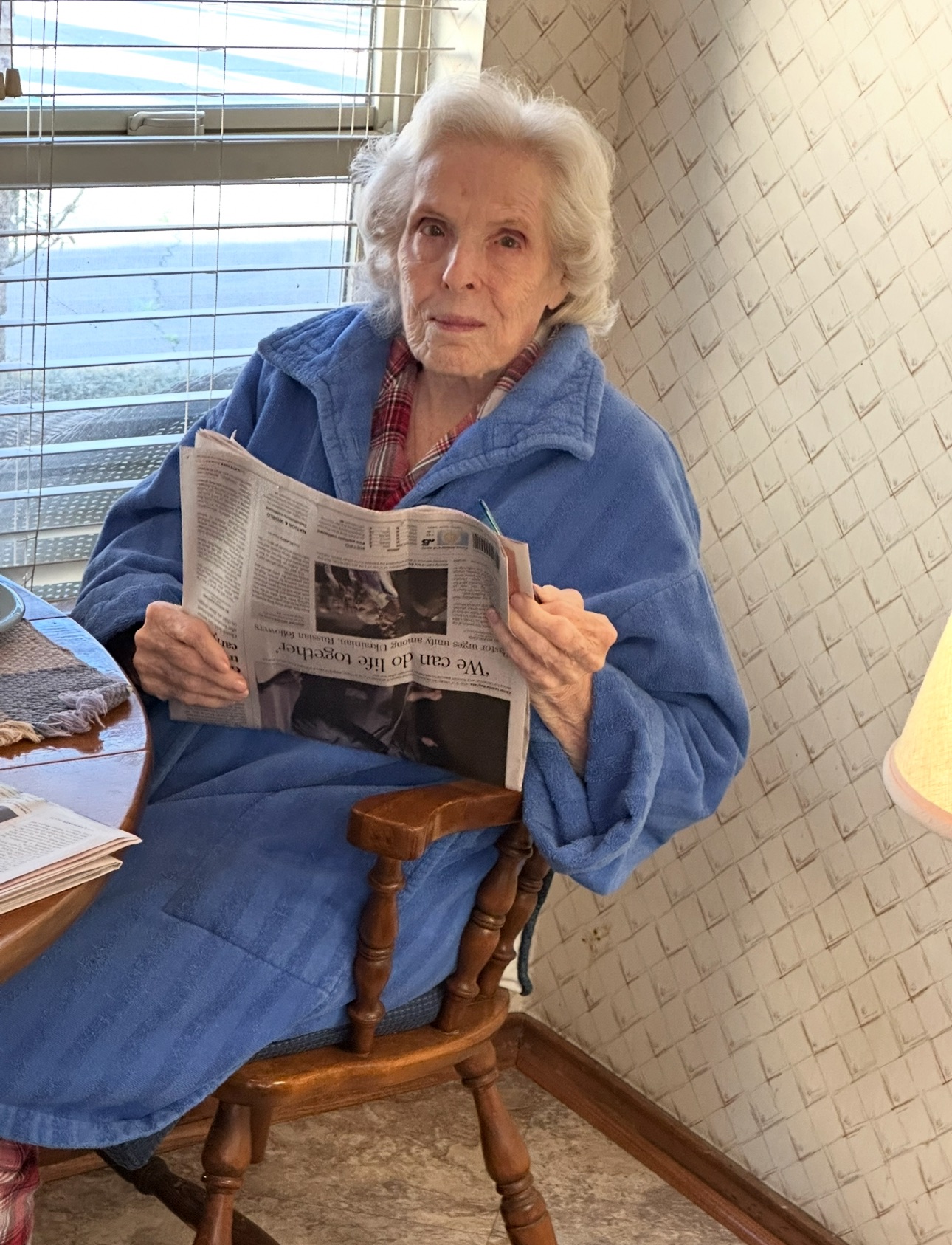
Toward the end of her life, as we sat across from each other at dinner one night, I asked her, “When did you feel most yourself?” There was a long silence. She seemed to go somewhere. Then: “Oh, I guess when I was 18 and working on the paper in Big Spring.” She did not say, “When I got married.” She didn’t mention her children or the comfortable life she led in her later years. She talked about her youth, when curiosity was what drove her, when she was still discovering what the world might show her.
She was naming more than youthful happiness. She was remembering the moment when hardship and purpose converged, when curiosity became vocation, and when the world — with all its absurdity, injustice, energy, and surprise — first opened itself to her. She was, at last, exactly where she wanted to be: combing the town, on the story, and she never lost that desire to be on the beat.
She was bold and brave until the day she died. It is hard to realize it’s already been a year. I still look for her everywhere. Even now, I want to know more. I read her clippings, I pore over her notebooks, I watch the videos I made of her at 89, at 93, at 95, at 97, at 99 – how I wish I’d made many more of them. I find her in the letter her friend Gem Bob once tried to edit and couldn’t, because she knew what she wanted to say. Each piece of her arrives when it arrives.
And I’ll continue to hold the image she held of herself. I will picture her at eighteen — walking her beat in Big Spring, before the marriage, before the children, before the long years of caretaking and loss and rebuilding. Just a young woman with a notebook and a dog who ran ahead. The reporter who already knew what she wanted: to have her finger on the pulse, to follow the story wherever it led.
I close my eyes and she is there. Byline already knowing the route.
November 1, 1925 – June 27, 2025
Ah Norman.
I loved this so much.
xo
This is a beautiful tribute to a remarkable woman. Several years ago we shared a table with your mother and her friend (Bobby?) at one of Betty’s cabaret shows in NY. We had no idea she was Betty’s mother until she introduced herself. We were thoroughly entertained and charmed. Such a lovely and wonderful woman.
Norman, I thoroughly enjoyed reading about your mother. What a great lady. Blessings sent your way.
It is hard to believe that your sweet mother has been gone for a year. What a moving tribute to her. The family & friends who spoke at the service shared such wonderful comments. We all shared tears & laughter that day. ❤️
What an inspiring lady! What a life! What spirit!
Thank you for sharing her story (and yours)
With respect,
Blessings,
Simon Beck
Simon, are you Bob and Paula Beck’s son? Bob was my supervisor as a fellow in social work at Baylor and I rented office space later on from Paula. You were a little boy (around 1983-1984) when the other fellow (Pat) and I came to your home for dinner a few times. Very fond memories of your parents. . . . If you are the same Simon Beck.
This is magnificent, Norman, and so was she!
You are so fortunate to have her writings from such a young age. The world was her oyster despite all the pain and suffering she had experienced as a child. Her attitude carried her through tough times, no complaints, just one foot in front of the other in pursuit of her dreams. What a wonderful story, Norman!
Norman—Thank you so much for this magnificent remembrance of your strong, interesting and fabulous mother. I live in the home I grew up in in Fort Worth and I can tell you that living in your mother’s home will give you a great deal of peace and comfort.
Betty Lynn was at Arlington Heights with me and I admire her so very much.
Lucy Brants
Such a lovely mother. I was given the most precious gift when I married Pat, I was given another mother, mine being gone since 1979. She really loved me like a daughter.
I’ve never met you or your mother, but I find you on Instagram a lot and this brief memoir about your mother is so good. She is so interesting and I can see her mind working. Even though I’m 82 years old, it’s never too late to be inspired. Thank you for sharing this.
I’ve never met you or your mother, but I find you on Instagram a lot and this brief memoir about your mother is so good. She is so interesting and I can see her mind working. Even though I’m 82 years old, it’s never too late to be inspired. Thank you for sharing.
She and your father both touched my life deeply since 1960 and I’m so happy it’s your base now. I had lovely special visits with her there and she’s still tucked into her cozy corner chair, reading… ❤️🙏